

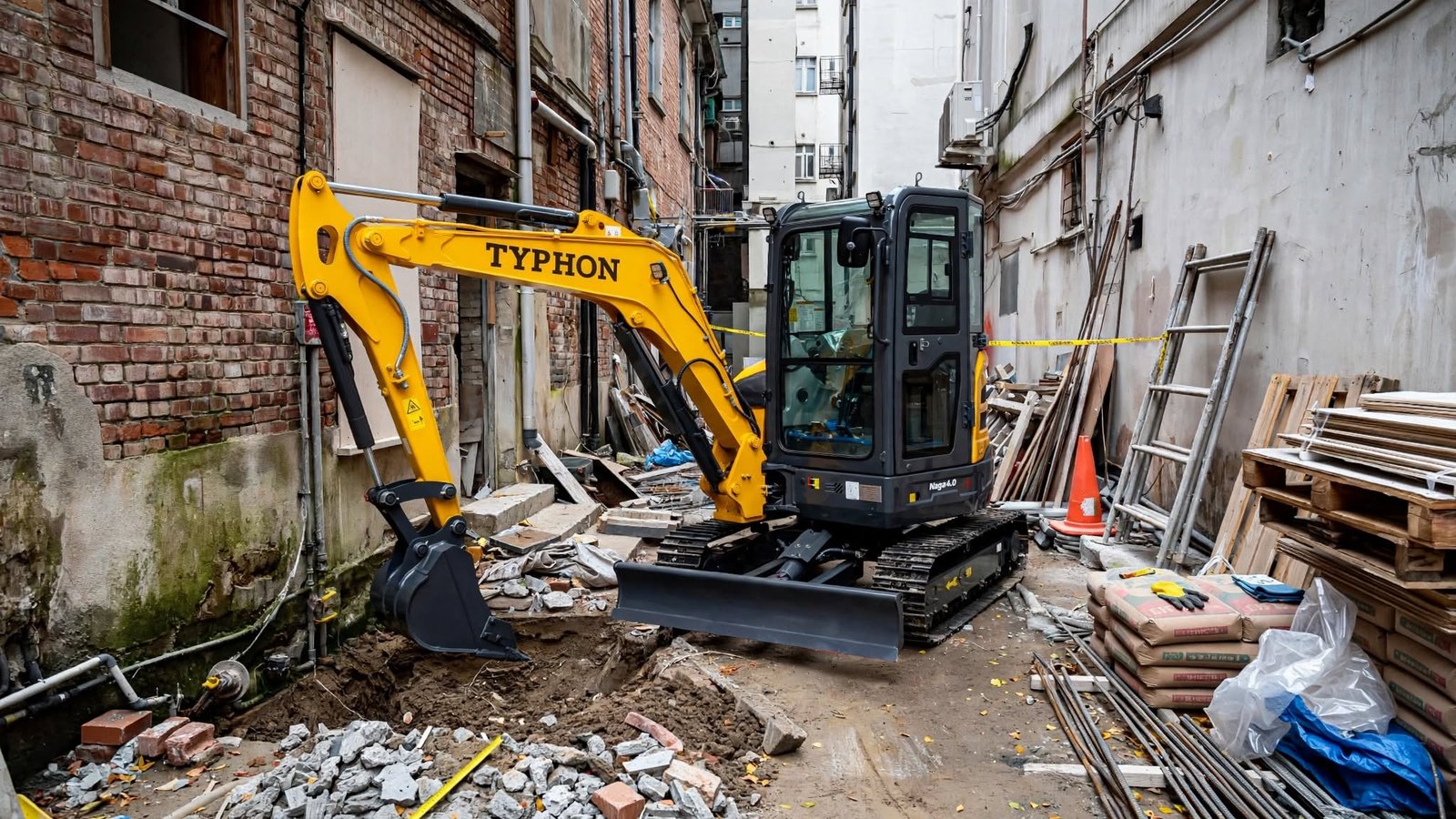
Why compact machines are better than large machines in tight spaces. If you’ve ever tried to get a large machine on to a tight residential site, you’ll know. The gate is just wide enough for the truck, the gradients in the driveway are steep, and there may also be a shed and fence limiting how much space you have. From the moment you arrive on site, you’re thinking that getting a large machine on site is going to take forever. In this instance, a compact machine is an excellent choice. It will allow you to complete this job quicker (before lunch), rather than having to reposition a large machine.
Large machines have their place, but for tight sites including residential sites, urban infill, backyard services, and tight access, compact machines are the best option. This is not just due to them being compact; they have been designed to perform efficiently in conditions that are far from ‘open spaces’.
Table of Contents
1. They fit through the Gate
This seems simple, but if you try to get a machine that needs 48” of width, through a 36” gate… you won’t get in. Simple.
Most compact machines (1-2 tonne) will easily fit through a standard residential gate. There are some even narrower. This means you can get directly into the backyard without having to destroy a section of fencing or ask your neighbour to let you across their garden.
Large machines weren’t designed to get in tight spaces like this. They work well on sites with good haul roads and staging areas. However, most contractors do not work on these types of sites regularly. Most days, they’ll be working on a residential site with a post box at the edge of the road and a curious dog looking out of the window.
So, 1 reason compact machines are better than large machines in tight sites is that you can get them in and get to work quicker.
2. Zero swing over means no worries
Zero swing over machines are great! As the name suggests, there is no tail swing. This means you can get right up to a foundation, fencing and even stationary vehicles without any risk of hitting anything you shouldn’t.
On tight sites, this feature can really make a difference. It can mean the difference between completing the trench and replacing a fence.
Mid sized excavators (and even large excavators) require a certain amount of space behind them. However, in residential sites, this space may not be available. As a result, you may be forced to park further away meaning you have less reach, or alternatively do the work by hand.
In this situation, compact machines are the better option. They have been designed to complete exactly this kind of task.
3. Less damage caused on entry
A 30 tonne machine requires solid ground, matting and a plan. However, compact machines only require a path.
This is very important. On completed ground such as grass, driveways and landscaped gardens, the damage from a large machine entering the site can be greater than the value of the excavation itself. Due to the soft rubber tracks, compact machines cause far less damage. You won’t ruin a perfect lawn to create a muddy mess that will cause complaints from the owner for months.
Contractors working on residential sites understand this. While they may not be delicate, they understand that avoiding causing additional work for themselves is key.
4. Easier transport
This is often overlooked.
To transport a large machine requires a low loader, and sometimes permits. The truck required to haul it must also be capable of supporting this weight. This means that even before you begin any digging, you may have spent half a day getting it on site. However, compact machines (especially below 2 tonnes) can commonly be transported on a regular trailer behind a pick-up truck. No CDL license, escort vehicles or booking the low loader in for Tuesday when you need it on Monday.
On short duration jobs, transport can eat in to your profitability. Therefore, compact machines can be a better option than large machines on shorter duration jobs. With compact machines, you’ll be spending less time transporting and more time working.
5. More precision
On tight sites, precision is key. Whether it be services, irrigation lines or foundations that need to be placed in exact positions, a large machine may be too clumsy. At times, precision is needed, rather than power.
With compact machines, you have more control. As the hydraulic system matches the size of the machine, you have more control with the bucket. You can easily be precise with cuts, reducing the risk of having to rely on the ground worker to signal you to stop.
Although this is not apparent in a spreadsheet, it can impact the amount of rework. Using large machines on tight sites can lead to incorrect lines, and therefore rework. However, the precision provided by compact machines means they give accurate results. For these reasons, compact machines are better for tight sites.
6. Lower costs
Fuel, servicing, parts, and insurance.
As compact machines have smaller engines, they will use Less Fuel. Soft rubber tracks will last much longer as you aren’t making them spin on concrete. Servicing is generally easy, as the machines were designed to be serviced by the user, and not a dedicated workshop.
Also, compact machines are cheaper to own, therefore cheaper to have on your trailer. As you aren’t paying for features you aren’t using, compact machines are a great investment. On tight residential sites, you don’t require large breakout forces to move large rocks – you simply need a machine to do the job, without emptying your bank account at the first sign of wear.
7. Easier to find operators
Currently, there is a lack of skilled operators. It can be difficult to find someone to operate a 30 tonne machine safely and efficiently. However, it is easier to find operators for compact machines. It is also quicker to train an operator on compact machines.
For growing contractors, compact machines allow people to be trained more easily. As the controls are intuitive, mistakes are less damaging, and as people gain more experience, skills transfer to larger machines.
While compact machines are not necessarily better than large machines, in this scenario, they are better due to availability of suitable operators.
8. The Real Story
Large machines aren’t going to disappear. There are situations in which they are required. Large depths of excavation, large scale site preparation, and large scale demolition.
However, most contractors do not regularly get the opportunity to work on these types of jobs. Most of the time, they will be working in tight access residential locations. In these locations, the machine must fit, avoid damaging the ground, and provide profit.
If you’ve tried to get large machines onto small sites, you’ll understand the expense. Re-positioning, damage, and time. Compact machines are a great option for tight sites, as they have been designed for the type of site most contractors are working on.
9. Final Thoughts
Once you try using a compact machine on a job that would have caused you a migraine with anything larger, you’ll no longer refer to them as small machines. They are simply the right machine.